Scaling DesignOps to support 226% revenue growth
Paisanos grew from 19 to 80 people in one year, and that broke the design process. I redesigned how Paisanos sold, designed and delivered products, turning a small startup's informal collaboration into a repeatable system that supported 226% revenue growth.
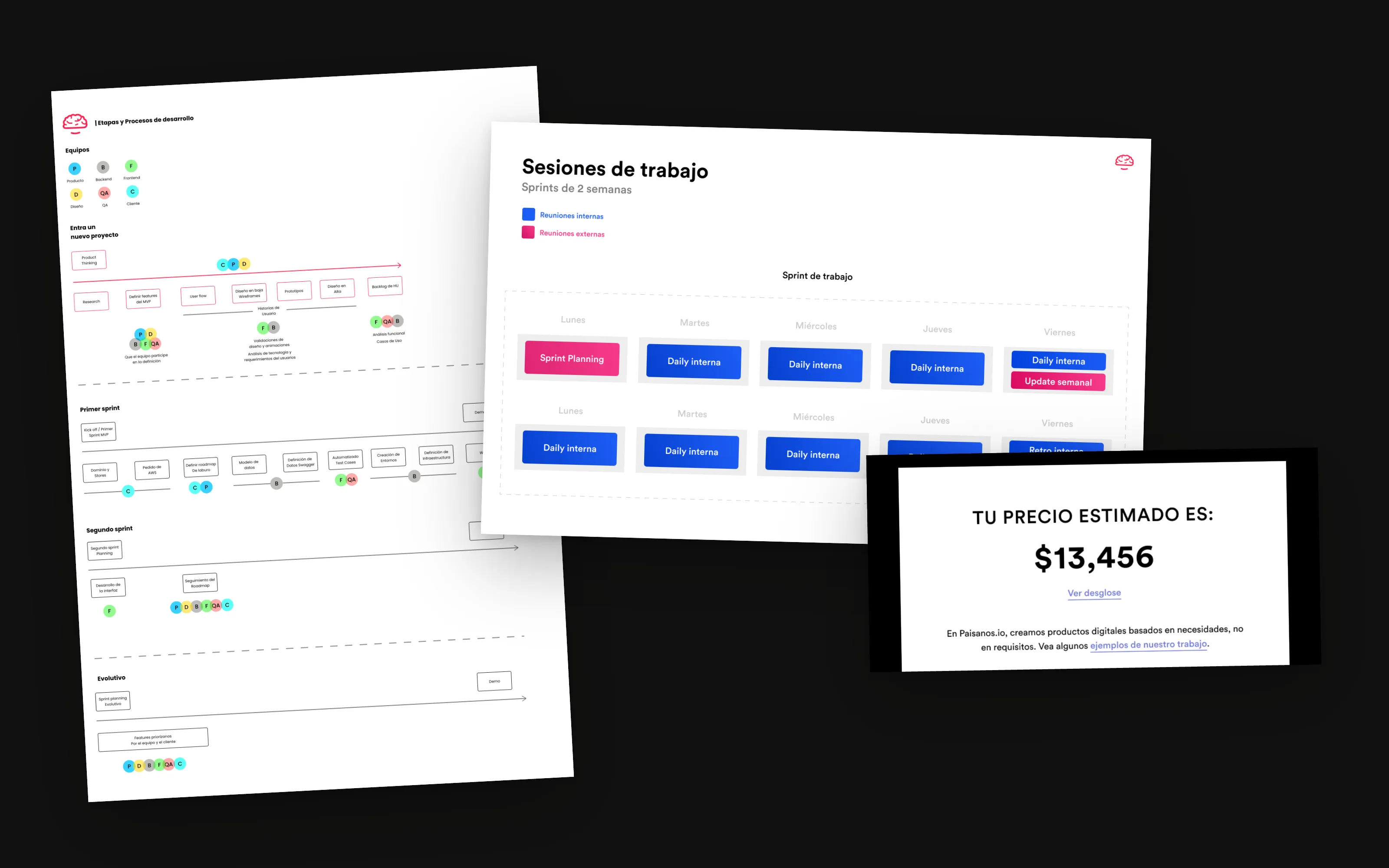
- Design team
- 5 → 20+
- Paisanos, 2020–2021
- Company size in one year
- 19 → 80 people
- Paisanos, 2020–2021
- Revenue growth
- 226%
- Paisanos, 2020–2021
- Average project value
- +40%
- Paisanos, 2020–2021
Team: design (20+), development, QA, PMs, operations · Duration: ~8 months · Tools: Figma, Notion, Miro · Industry: agency
The problem: scaling faster than our process
I joined Paisanos during the pandemic, when the company was in the middle of rapid growth. Projects got bigger and more complex, and the pressure to deliver increased.
Like most startups, the early approach was simple: work long hours, iterate until it feels right, then ship. That works at a small size. As the company grew, it created real problems:
- Documentation. Design documentation varied between teams, slowing handoffs and creating confusion at every stage.
- Development. Developers joined projects too late, leading to rework, missed constraints and avoidable technical debt.
- Feedback. Client feedback cycles had no defined format, creating misalignment and slowing decisions.
- Scope. Without defined milestones, scope expanded unchecked, damaging timelines and client trust.
Discovery: listening before changing
Before designing anything, I ran semi-structured interviews with every team in the company: design, development, QA, operations and sales. I focused on four questions:
- What’s working well today?
- If you could change one thing about our process, what would it be?
- If you could ask something from another team, what would it be?
- What’s the one thing we could do to improve client relationships?
The answers pointed to the same four needs: clear responsibilities, better documentation, defined checkpoints with clients and a modular process. The teams were good. They weren’t aligned.
Solution: designing the delivery system
The previous process was a skeleton: broad milestones with no defined stages, responsibilities or documentation standards. Instead of replacing it, I extracted what worked and built around it. As a newcomer, my priority was collaboration over imposition.
The result was a four-stage delivery system. Each stage could validate an idea on its own before the next one started:
- Validar. Business validation. Most clients lack clarity on monetization and customer definition.
- Diseñar. Research to prototype, with full documentation for the internal team or the client’s developers.
- Construir. Sprint-based development with defined milestones and clear scope.
- Mejorar. Improvements in bi-weekly sprints, based on real user data.
- 01ValidarBusiness validation
- Kick-off
- Business design
- Experiments
- 02DiseñarResearch to prototype
- Research
- Analyse
- Visualise
- Design
- 03ConstruirSprint-based build
- MVP
- Development
- Testing
- Launch
- 04MejorarImprove with real data
- Bi-weekly sprints
- User data
- Iterate
Research
- Desk research
- Stakeholder interviews
- Exploratory interviews
- Motion concepts
Analyse
- Jobs to be done
- User stories
- Feature prioritisation
- Site maps and user flows
- Wireframes
- Usability tests on wireframes
Visualise
- Exploration
- Moodboard
- Motion
- UI kit
- Style guide
Design
- Mockups
- Prototypes
- Animations
- Usability tests on mockups
- Design QA
Product acceptance document Scope and technical needs, signed off by the client before visual design starts.
Design acceptance document Everything development needs for the hand-off.
Validation: testing with real projects
We stress-tested the framework on two client projects. By validating product–market fit independently, we pivoted both clients into more profitable products. After each project we ran retrospectives focused on the process, not the deliverables.
- Benchmarking was cut. Competitive benchmarking at the start of design had turned into cherry-picking features that only added friction.
- The creativity timebox stayed, with structure. Designers found an open window to “be creative” disorienting, so I kept the timebox and added deliberate practice sessions and structured design reviews.
- Bi-monthly presentations became the feedback loop. Presenting the process to different teams every two months forced us to keep refining it.
Business impact
Once every client went through a business design phase, we stopped building products nobody needed. We had more successful launches, stronger case studies and the proof we needed to raise our rates.
- Business validation by default. Every client went through validation before design began. Bad ideas died early, before either side had spent much on them.
- A modular service offering. Validar, Diseñar, Construir and Mejorar became standalone products. Clients could enter at any stage, so sales could close more deals.
Key takeaways
- Collaboration over imposition. I could have brought my own process from day one. People adopt what they helped build, so I designed for adoption first and optimization second.
- Context beats methodology. A fully agile approach created scope creep that damaged client relationships. First-time founders need structure, not open-ended iteration.
- Checkpoints create trust. Every team knew what was expected at each stage, and clients had visibility without micromanaging.
- DesignOps is organizational design. The process connected sales, design, development and operations into one system.